


Senate panel advances death penalty bill for murder of peace officers
February 27th, 2025 by Ric Hanson
(Des Moines, Iowa) – A Senate subcommittee advanced this year’s proposal to reinstate the death penalty in Iowa in cases where a person is found guilty of the intentional killing of a peace officer. The Iowa Capital Dispatch reports Iowa abolished capital punishment in 1965. But Republican lawmakers have proposed bringing back the practice for specific crimes multiple times in recent years. In 2024, lawmakers considered a proposal to reinstate the death penalty for cases in which a person is convicted of first-degree murder for intentionally killing a police officer or prison employee.
The 2025 bill, Senate File 320, is another attempt at implementing the death penalty for the crime of first-degree murder of law enforcement officers. Under current Iowa law, the intentional killing of a peace officer, correctional officer, public employee, or hostage by a person imprisoned in a correctional institution constitutes a first-degree murder charge. The legislation would create a new first-degree murder charge for when a person “intentionally kills a peace officer, who is on duty, under any circumstances, with the knowledge that the person killed is a peace officer.”
The death penalty, by lethal injection, could be considered when a person is convicted on the charge of intentionally killing a law enforcement officer. Sen. Dave Rowley, R-Spirit Lake, said the legislation came at behest of the family of Officer Kevin Cram, an Algona police officer who was shot and killed in the line of duty in 2023, as well as others in the state who expressed concerns about justice served after law enforcement officers are killed.
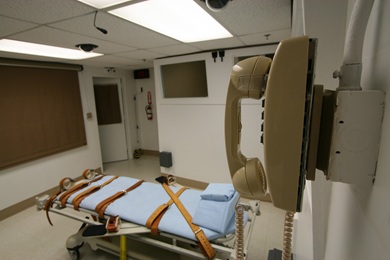
Wikipedia image
A majority of speakers at the subcommittee meeting were opposed to the legislation. Many representing faith groups said the state as an entity should not have the power to decide to end an individual’s life. The Death Penalty Information Center, a nonprofit organization focused on capital punishment, found at least 200 people in the U.S. who have been sentenced to death since 1973 were wrongfully convicted and have been exonerated. Multiple studies, compiled by the organization, have found the death penalty does not effectively deter crime in states where the punishment is used.
Several opponents to the measure said reinstating the death penalty would come at a high cost to the state. Jen Rathje with the Iowa Department of Corrections said the department, working with the Department of Administrative Services, found implementing the death penalty would come at a “conservative” estimated cost of $3.45 million, a figure that does not take into account additional materials or equipment that would be required to carry out executions.
Senator Rowley said the death penalty would just be “an option” in the justice system as families, like the family of Officer Cram, seek closure following the murder of their loved ones.

 Facebook
 Twitter
 YouTube
 RSS
RSS