


Iowa science teacher uses the prairie as a classroom
December 31st, 2024 by Ric Hanson
(Panora, Iowa/Iowa Capital Dispatch) – A science class for middle school students at Panorama Middle School commonly involves a trek out to the prairie behind the school, a sketch of native seeds under the microscope or a homework assignment to track the progress of a backyard bluebird from its birdhouse. Teacher Mark Dorhout created an outdoor education program at the middle school in Panora to “connect (students) to the natural world,” foster environmental stewardship, and give students a real-world application to the science they learn in the classroom. Dorhout, who has a degree in wildlife and fisheries sciences, spent the majority of his career teaching or administering at middle schools and has been teaching sixth through eighth grade science at Panorama Middle School for four years. He started the outdoor education program by taking students out to a recently restored prairie behind the school, and using the school’s backyard in his lessons as much as possible.
“This has been a long-standing passion of mine that has become more and more apparent as we move along in this society,” Dorhout said. “And really the main thrust to that is that kids are out less and less into this environment.” Now the class and its non-traditional classroom has a reputation among the middle schoolers — all of whom will go through the project, make a birdhouse, and get to meet Dorhout’s Labrador retriever, which never misses a field day. Dorhout said he’s thankful the school district has been very supportive of the program and works with him to supply materials and promote the course in newsletters to parents. “They get it,” Dorhout said of his district. “They understand the value of a program like this.”
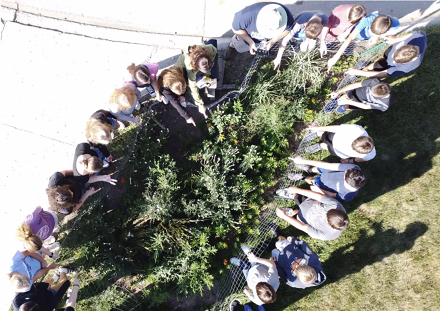
Students observe a “pocket prairie” installed by teacher Mark Dorhout who leads an outdoor education program at the middle school in Panora. (Photo courtesy of Mark Dorhout)
Dorhout said the 11-acre prairie behind the school has been there for over 20 years but really fell out of use until seven or so years ago when the local members of the Izaak Walton League worked to “grub out” some of the trees that had overtaken the area, and replant it to prairie. Each grade has a different project. Seventh graders build either a bluebird or a wren box that they take home, hang on a tree, and monitor through the rest of their time in middle school. “They never knew that there was the whole other thing going on … and then all of a sudden they’ve started paying attention to the birds in the neighborhood,” Dorhout said. Eighth grade students get to work in the greenhouse as part of their curriculum on genetics and climate change. Last year he added sixth graders to his docket and uses the prairie for their lessons in water quality and chemistry. Dorhout said going out and conducting water quality tests gives the students a real life application of the chemistry they learn in the classroom.
And all of the students get about 50 field days over the course of their time in middle school. Throughout the program, Dorhout has his students gather seeds, add plants into the prairie and analyze what makes one section of the prairie better than another. All of it leads to pretty “rich conversations” around soil quality and biodiversity. “Kids that you wouldn’t think would like doing prairie work, just totally get into it,” Dorhout said.
Dorhout spoke about his class during a Watershed Talk with the Iowa Division of the Izaak Walton League of America Dec. 17.


 Facebook
 Twitter
 YouTube
 RSS
RSS