


Judge rejects Homeland Security’s arguments in UI student visa case
July 23rd, 2025 by Ric Hanson
On June 12, 2025, DHS filed a motion seeking to revise the injunction. The department argued that due to technological limitations with SEVIS records, the system did not allow the creation of written notations that would be visible to other users of the system, such as schools and employers, outside of DHS. Attorneys for the agency also informed the court that the four student plaintiffs were each sent letters confirming their student status was retroactively reinstated, and argued the students could present those letters to anyone questioning their status. DHS asked that the court issue a ruling indicating it had fulfilled the requirements of the injunction, while also arguing the injunction was overbroad and amounted to a prohibition against any sort of prosecution for crimes the students might commit.
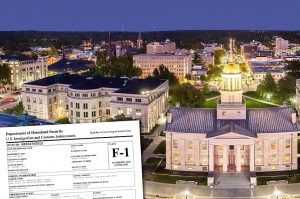
(Main photo courtesy of the University of Iowa; form courtesy of the U.S. Department of Homeland Security)
Noting that DHS had made no assertions as to what, if any, efforts had been made to remedy the claimed technological limitations within SEVIS, U.S. District Court Judge Rebecca Goodgame Ebinger denied DHS’ motion to revise her order. As for the letters DHS provided the students, Ebinger indicted the letters didn’t fully address the students’ risk since they wouldn’t necessarily be present when schools or employers examined SEVIS records and questions arose as to their status. “The court does not find this proposed alternative solution adequate to provide complete relief to plaintiffs,” Ebinger stated. With regard to DHS’ claim that the injunction bars future criminal prosecutions, Ebinger noted that her order does not apply to state, county, or local law enforcement acting separately from DHS and not at DHS’ instruction. Also, she ruled, the injunction “prevents neither arrests nor the commencement of prosecutions. Rather, as to the plaintiffs — four individual people whom the court previously found to be likely to succeed on their claims of unfounded and harmful status record interference — the court’s order requires advance notice to the court as part of defendants’ due process efforts. The order does not prohibit law enforcement actions.”
The three University of Iowa international students and one UI international-student graduate are suing Homeland Security for having revoked their status as students — a step they fear could lead to being detained and deported. In June, lawyers for Homeland Security asked for, and received, a 60-day extension of time to file an answer to the case. As justification, they said “the small civil division for the U.S. Attorney’s Office has recently been experiencing significant staffing shortages,” and the issues raised in the UI case have been the focus of “significant litigation around the country,” resulting in a need for additional time is needed to coordinate any response to the lawsuit with others inside the U.S. Department of Justice.
The government’s lawyers now have until Aug. 21, 2025, to respond to the students’ lawsuit.
 Facebook
 Twitter
 YouTube
 RSS
RSS