


What to expect from the 2025 Iowa legislative session
December 30th, 2024 by Ric Hanson
(Des Moines, Iowa/Iowa Capital Dispatch) – As Iowa lawmakers get ready to reconvene Jan. 13 for the 2025 session with new members, leaders said they are heading into the session with expectations to take on property taxes, changes to the state’s higher education system and immigration policy, among other issues. Following the 2024 general election, the 91st Iowa General Assembly will bring some new lawmakers to the State Capitol – including adding more Republican members both chambers. Senate Republicans grew by two seats to a 35-15 supermajority in the Senate – with one seat now open as former Sen. Chris Cournoyer took the office of lieutenant governor. House Republicans expanded their majority to a 67-33 supermajority in the House.
House Speaker Pat Grassley said in an interview with Iowa Capital Dispatch that although there are more members in the House Republican caucus, much of their approach to legislating will be the same. Having GOP supermajorities in both chambers – in addition to Republicans holding all but one statewide elected office – means Democrats have little control over what legislation and topics are brought up in the upcoming session. However, Democratic leaders said there are still areas for collaboration with the majority party. House Minority Leader Jennifer Konfrst said House Democrats are still focused on their “people over politics” agenda and plan to introduce legislation on issues like supporting public education, reproductive health care, legalizing marijuana, and lowering the costs with housing and child care.
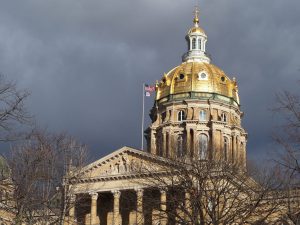
The Iowa Capitol on Dec. 20, 2024. (Photo by Robin Opsahl/Iowa Capital Dispatch)
In previous sessions, House Democrats have worked with their Republican colleagues on measures like the 2023 property tax law that passed with bipartisan support, Konfrst said. This year, she said issues like housing and child care support could be issues where members can work together to find bipartisan solutions. Senate Minority Leader Janice Weiner said in addition to efforts to work with Republican supermajorities, Democrats also play an important role in the Legislature in making sure the majority party takes “accountability” for measures passed. Weiner said Democrats will look at the impact of GOP-passed measures like the changes to the state’s individual income tax and the cost of the state’s Education Savings Account program that will go into full implementation without income caps beginning in the 2025-2026 school year.
With the Iowa Revenue Estimating Conference estimating earlier in December that the state will see a drop of roughly $600 million in annual state revenues this fiscal year compared to the previous year, Democrats said there is a need to review laws to ensure the state’s future fiscal health. Konfrst said that the REC estimates show a need for the state to take a new approach to budgeting – and that the estimates show current budgeting practices are “unsustainable.” But Grassley said the declines in revenue were expected and measures like the 2024 income tax law built in provisions that allow the state to use the existing budget surplus and funds in the Taxpayer Relief Fund to make up for loss of revenue. Grassley said Republicans feel good about the “long-term viability” of these tax changes in coming years.
While budgeting typically comes near the end of the legislative session, there will be numerous policies proposed, discussed and passed at the State Capitol starting in January.


 Facebook
 Twitter
 YouTube
 RSS
RSS