

KJAN News can be heard at five minutes after every hour right after Fox News 24 hours a day!
Keep up-to-date with Fox News Radio, Radio Iowa, Brownfield & the Iowa Agribusiness Networks!


KJAN News can be heard at five minutes after every hour right after Fox News 24 hours a day!
Keep up-to-date with Fox News Radio, Radio Iowa, Brownfield & the Iowa Agribusiness Networks!
(Indianola, IA) — Sheriff’s officials in Warren County, Friday afternoon, reported a woman who had been missing earlier in the week, and whose abandoned vehicle was found in Ringgold County, was found alive and safe. 78-year-old Cheryl Anderson was located in rural Ringgold County, and was being evaluated and treated by medical personnel, Friday.
Anderson, who has Alzheimer’s, went missing on Tuesday after leaving her residence in Cumming. Investigators said her vehicle was found stuck near an intersection in rural Ringgold County Wednesday night, but she was not found at that point. Multiple agencies assisted with the search throughout Thursday and Friday.
Authorities thank everyone who was involved in the search for Cheryl Anderson.
(Radio Iowa) – Daylight Saving Time begins Sunday and it has become a tradition to test your smoke alarms while also turning clocks ahead one hour. Sioux City Fire Lieutenant John Nelson says it’s important to make sure the detectors are working.
“It’s always important to make sure that all of our safety equipment works in our house. And that is a good reminder to check our smoke alarms and making sure that they are current, they’re within the ten-year window,” he says. “If you look on the back of your smoke alarms, you can see almost like a manufactured date. And the manufacturer suggests they have a ten-year lifetime.
Nelson says many new smoke detectors have a sealed battery that you don’t need to change for ten years. He says you should still check them. “Like anything, it doesn’t always mean they’re going to last the full 10 years, and it’s always important to test the functionality of those smoke alarms to make sure that they are still working,” Nelson says. Many smoke detectors also have a carbon monoxide alarm with them.
Nelson says check that detector as well and replace it if it is not working. Also be sure the devices are put in the right place. “People that do have them typically keep them next to their furnaces down in the basement. Unfortunately, when we need them to alert us is at night when we’re sleeping,” Nelson says. “So we always recommend having them outside our sleeping quarters, whether it’s in the hallway or even in the bedrooms themselves.”
Nelson says working smoke alarms cut the risk of dying in a home fire in half, as you only have about two minutes to escape in most instances.
(Atlantic, IA) – The Cass County Sheriff’s Office reports six arrests took place between Feb. 27th & March 3rd.
Authorities say 45-year-old Matthew Bernard Steffens, of Atlantic, was arrested February 27th on a Sex Offender Registration violation – 1st Offense (failure to update relevant information). Steffens was booked into the Cass County Jail and held.
On March 3rd, Sheriff’s Deputies in Cass County arrested 35-year-old Charles Albert Mace, Jr, of Atlantic, on charges of Sex Offender – Verification Violation/1st Offense, and for two counts of Sex Offender Registration – 1st Offense (failure to update relevant information). Mace was transported to the Cass County Jail where he was booked and later released on bond.
Three people were arrested March 3rd on drug charges in Cass County:
40-year-old Summer Lynn Cole, 37-year-old Shea Michael Young, and 41-year-old Amber Lynn Rhodes, all of Atlantic, were arrested for Gathering Where Controlled Substance Used, and Possession of Controlled Substances. All three were transported to the Cass County Jail, booked-in, and held.
On March 5th, 67-year-old Terry Lee Ranney, of Massena, was arrested on a Cass County Warrant for Civil Contempt of Court. Ranney was transported to the Cass County Jail where he was booked-in and later released on bond.
(Des Moines, IA) – The Iowa Department of Natural Resources is accepting public comment on a proposed increase to the price of resident and nonresident hunting, fishing and trapping licenses, tags and fees. If approved, the new prices will go into effect on Dec. 15, for the 2027 recreation year.
The proposed price of a resident hunting and resident fishing license would increase by $1, resident deer license by $1.50, resident trout fee by $0.50, and resident lifetime hunting and lifetime fishing by $2.50. The increase will apply to all licenses and fees.
This is the first license fee increase since 2019.
Comments may be emailed to wildlife@dnr.iowa.gov, given verbally by calling 515-201-3376, or in person at 1 p.m., March 24, at 6200 Park Avenue, Suite 200, in Wildcat Den conference room, in Des Moines. Public comments will be accepted through March 24. The fee increase was approved at the February meeting of the Natural Resource Commission.
(Radio Iowa) – The Ag Committee in the U.S. House has passed an 800-page Farm Bill that would set federal agriculture and food assistance program rules and spending for five years. The 2018 Farm Bill expired in 2023, but congress could not agree on a new version, so it approved extensions — and some program updates were included in the “One Big Beautiful Bill” President Trump signed last summer. Democrats say the Farm Bill that’s proposed is flawed because it does not include change U.S. tariff policies or make year-round E-15 sales federal policy.
The House Ag Committee’s Republican chairman says those decisions are outside of the committee’s jurisdiction. Iowa Congressman Randy Feenstra, a Republican from Hull who’s been leading negotiations on a separate E-15 bill, says it’s unreasonable for Democrats to demand that those items be included in the Farm Bill. “Here’s the thing: farmers and ranchers, they want our help. They want this bill. They need it because it’s the next step. I would have loved to have done it in 2024. We had bipartisan support in 2024, but it didn’t happen. Then we tried it in 2025 and now it’s 2026,” Feenstra said.
“Are we going to come together and get this done or not?” Feenstra is a member of the House Ag Committee. Iowa Congressman Zach Nunn, a Republican from Ankeny, is on the panel, too, and he says the Farm Bill that cleared the committee Thursday will provide certainty to the farming community. “But the Farm Bill is only part of the equation for Iowa’s 87,000 family farms and hundreds of thousands of farmers across our country. They need certainty when it comes to things like biofuel policy,” Nunn says. “…We owe it to our farmers, our families and our friends to deliver certainty and stability in the market and that means year-round, nationwide E15.”
Seven Democrats joined Republicans on the committee to advance the Farm Bill, making it eligible for debate in the U.S. House. The proposed Farm Bill includes a provision that has been introduced in the Iowa legislature. It would shield pesticide manufacturers that follow E-P-A labeling guidelines from lawsuits alleging the chemicals cause cancer.
(Radio Iowa) – A sixty-five acre tract of land in southwest Iowa near the Missouri border is being donated to Taylor County, providing a natural space that will be preserved and turned into a public use area for future generations to enjoy. County Conservation Director Zoie Lecy says life-long county resident Jim Gamel is one of the last members of his family who still lives in the area.
“Twenty-seven acres of that has been in his family since 1973, so he’s had this in his family for a long time,” Lecy says. “He just wants to pass down something from his family and let the families of Taylor County and the residents of Taylor County and the surrounding counties have an opportunity to have something that they’ll enjoy and think back on his family legacy for a long time.”
The land is located in the Ross Township and is part of the larger Gamel farm of about 100 acres. Lecy says plans are in the works for what will be called the Gamel Recreation Area. While row crops were grown on the land at one time, Lecy says it has been mostly used for pasture, with some timber that could also present future hunting opportunities.
“In the middle of that property is a pretty decent sized ditch that we would like to utilize into a smaller lake, probably like a 3.5 acre lake,” Lecy says. “We’d also like to bring in camping and there’s an opportunity for hunting and we’ll bring in some trail systems and stuff like that.” Lecy says contractors have begun scoping out the area for the lake and dam development, with seasonal crews expected to come in later this year to tackle tree removal and create more space for trails.
She adds they also hope to have a variety of aquatic life in the lake, including bluegill, bass, catfish, and crappies. Lecy says the project is a once-in-a-lifetime opportunity for the county to expand its parks and recreational areas. “A lot of people don’t have the opportunity or the money or the means to be able to donate something like this to the county,” Lecy says. “This opens up a whole new world for conservation as we get to start a park that’s fresh to do what we think would be best for the people of Taylor County and the communities around it.”
She says the gift is very important to Gamel, “to be able to give back to those families and people of this county and community that’s been a part of his whole life.”
CARSON, Iowa – March 6, 2026 – Crews from the Iowa Department of Transportation’s Creston construction office need to close the U.S. 59 bridge over Iowa 92 in Carson on Monday, April 6, until late October, weather permitting, so the bridge can be removed and replaced.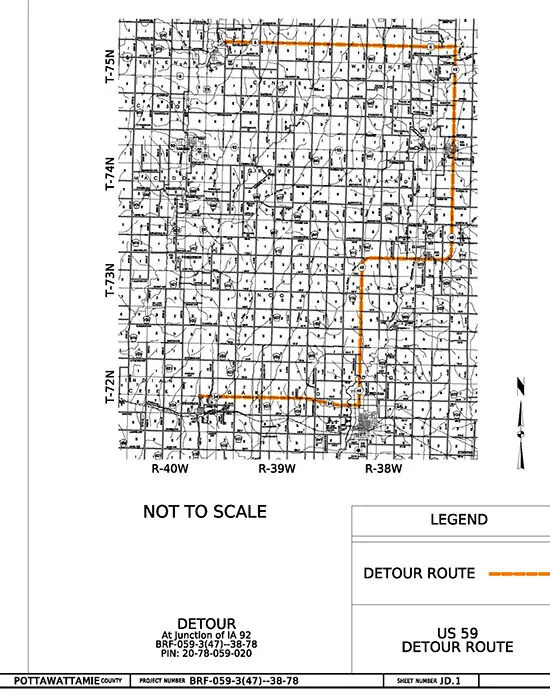
When the bridge and roadway is closed, you will need to follow a marked detour route that uses U.S. 6, Iowa 48, and U.S. 34.
(IOWA CAPITAL DISPATCH) – Bills to prohibit cloud seeding in Iowa, raise the punishment for animal torture and require state prioritization of vehicles with biodiesel fuel capacities were sent to the Senate following House approval Thursday. House File 2640 would prohibit the intentional emission of air contaminants for the purpose of “affecting the temperature, weather, climate or intensity of sunlight.” The bill would prohibit geoengineering practices, or methods to reduce the impacts of climate change by releasing certain properties into the atmosphere. One form of geoengineering, called cloud seeding, involves the release of silver iodide crystals into certain types of clouds to trigger rain or snow.
The U.S. Government Accountability Office holds that while several states utilize cloud seeding technology, its benefits are “unproven.” A similar bill has also advanced in the Senate, though the bills are not identical. The House adopted an amendment that struck the first portion of the bill, which would have required public airports to submit regular reports on aircraft at the terminals with equipment that could emit weather-changing particles into the atmosphere. The amendment also specified that the aerial application of agricultural inputs, like pesticides or fertilizers, would not be affected by the bill.The bill passed with a vote of 59-26 along party lines.
The House voted unanimously Thursday to pass House File 2348, which would elevate animal torture from an aggravated misdemeanor to a class “D” felony in Iowa. The bill alters code to specify that someone is guilty of animal torture if they perform actions that intentionally crush, burn, drown, suffocate, impale or subject an animal to serious injury or death. Class “D” felonies are punishable with up to five years confinement and fines of $1,025 to $10,245, according to the bill
Another bill, passed from the House Thursday, would require that diesel engine passenger vehicles leased by the state be manufactured with the capacity to run high blends of biodiesel fuel.House File 2671 provides that diesel engine vehicles rented or leased by the state must be capable of running on B-20, a blend with 20% biodiesel fuel, or higher blends. This brings biodiesel requirements for leased and rented vehicles in line with state requirements for purchasing diesel engine vehicles.
An amendment was added to the bill and adopted by the House to stop the Iowa Department of Administrative Services from limiting the number of events held at the state Capitol complex to one event. HF 2671 passed with a vote of 85-1 with Rep. Mark Cisneros, R-Muscatine, as the sole no.
BRIDGEWATER, Iowa – March 6, 2026 – Effective April 6th (2026), if you travel on Iowa 92 near Bridgewater you need to be aware of an upcoming bridge closure that may affect your trip according to the Iowa Department of Transportation’s Creston construction office.
Crews will need to close the Iowa 92 bridge over the West Fork of the Nodaway River, 1.6 miles east of Adair County Road N-51, on Monday, April 6, until late October, weather permitting. When the bridge is closed, you will need to follow a marked detour route that uses Iowa 148, Adair County roads G-61 and N-72, and Iowa 92.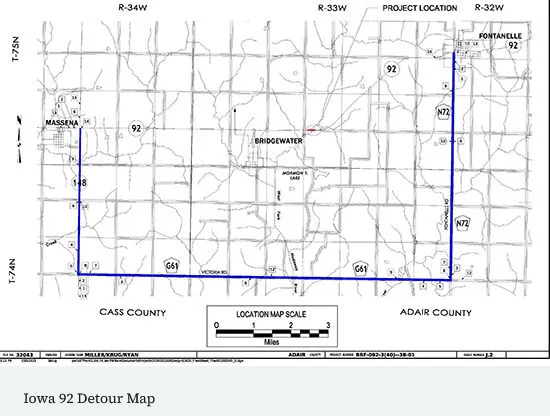
(Radio Iowa) – The Iowa House and Senate have unanimously approved a bill that sets some state rules for prior authorization — the process insurance companies and government-run insurance programs use before approving a patient’s medical treatment. It sets new timelines for prior authorization decisions. It also says a patient’s doctor appealing denial of treatment or medication for a patient must talk to an insurance company representative who’s an expert in the same area of medicine. Representative Austin Harris, a Republican from Moulton, notes the bill also makes changes that should speed up the process of state approval of health care facility construction.
“It is probably one of the most impactful pieces of legislation that will get down to the governor this year,” Harris said. “It is going to make sure that we expand services and provide quicker care for the people of Iowa.” Senator Kara Warme, a Republican from Ames, says the new prior authorization guidelines are likely to decrease the amount of time doctors spend talking to insurance companies. “We want time for our limited professionals to be in patient care with Iowans,” Warme said.
The bill also makes it illegal for insurance companies to use Artificial Intelligence to authorize or deny medical treatment.

 Facebook
 Twitter
 YouTube
 RSS
RSS