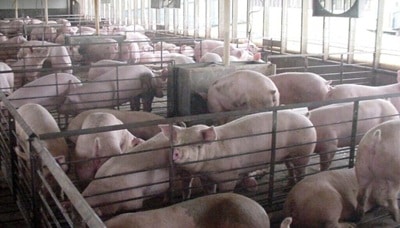
(An IOWA CAPITAL DISPATCH report) – Iowa’s official database of animal feeding operations, which serves as the state’s primary regulatory inventory of livestock facilities, does not include thousands of facilities that researchers say contribute to the state’s growing manure burden and potential water pollution. (cover photo credit: by Kent Becker, United States Geological Survey)
After spending about a year reviewing aerial photographs, satellite imagery and state records, researchers with the Environmental Working Group (EWG), an environmental advocacy organization, identified 15,309 livestock facilities across Iowa using data current through July 2025, more than 4,000 additional operations beyond the roughly 11,000 listed in the Iowa Department of Natural Resources database.
The difference does not necessarily mean Iowa has overlooked thousands of regulated livestock facilities. Instead, the two inventories measure different things. In an email, the Iowa Department of Natural Resources said its animal feeding operation database, which is updated daily, was developed to administer state and federal regulations and “does not include all animal feeding operations in the state.” The database does not include small confinement operations and open lots that are not subject to state or federal regulations, the agency said.
The Environmental Working Group’s inventory, by contrast, sought to identify every active livestock facility the researchers could verify using aerial imagery and public records, including many operations that fall outside the state’s regulatory database. The study authors said their analysis included facilities with at least 50 animal units, while the DNR data file generally includes facilities with more than 300 animal units.
For the analysis, the researchers classified facilities using the Environmental Protection Agency’s animal-unit thresholds. Operations with fewer than 300 animal units were classified as small, those with 300 to 999 as medium-sized and those with 1,000 or more as large. An animal unit represents 1,000 pounds of live weight — the equivalent of one beef cow, about 2.5 hogs or 125 chickens.
The researchers included livestock facilities of every size, not just those subject to state regulation, arguing that even smaller operations contribute to Iowa’s manure load and potential water pollution. The mapping also documents the continued consolidation of Iowa’s livestock industry.
The researchers identified 4,444 large facilities in 2025, a 12.9% increase from the 3,936 they documented in a similar statewide analysis in 2019. Schechinger said the study documented an increase in the number of large livestock facilities but did not track whether existing facilities had expanded. That, she said, would require additional analysis.
Researchers have observed similar trends in other major livestock-producing states, including Minnesota and North Carolina, but Iowa stands apart because of the sheer concentration of hog production. Five counties with the largest number of livestock facilities— Sioux, Lyon, Plymouth, O’Brien and Washington — contained 3,095 operations, or about one in every five livestock facilities identified statewide, according to the study.
The study is likely to add momentum to an ongoing debate over whether Iowa’s oversight of livestock operations adequately reflects the industry’s size and environmental footprint.
This article first appeared on Investigate Midwest and is republished here under a Creative Commons Attribution-NoDerivatives 4.0 International License.